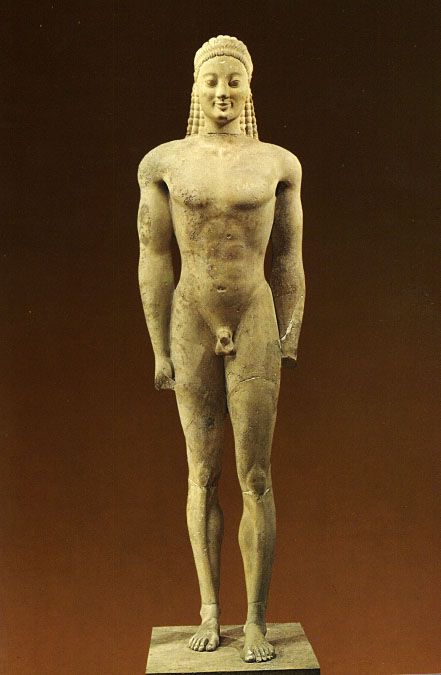
Kouros of Valomandra
The Kouros of Valomandra (570-550 BC), which is located in the National Archaeological Museum in Athens, is the most representative of the middle Archaic period. It was found in 1900 in Valomandra of Kalyvia. It was rescued after being seized by antiquities smugglers, who transported it to Athens, and was first published by Kavvadia in 1902, who excavated the entire ancient cemetery of Valomandra. It is located in the National Archaeological Museum, stands at 1.79 m tall, and dates approximately to 570-550 BC. It is the most representative of the Middle Archaic Period (580-535 BC) and according to Richter, it characterizes the entire group of Kouros (Valomandra group). The main characteristics of the evolution of Kouros of this period are that the decorative rendering has been done with great skill, and although the origin from rectangular blocks is still evident, now more details of the body are given with more rounded forms. Certainly, the most important characteristic is the movement of the Kouros, which with the Kouros of Valomandra, as well as with the Kouros of the same period, begins slowly to outline the evolution of the Kouros of the following periods. For the era it was found, it was characterized by P. Kavvadia as “the statue appears to be the most perfect of such statues”.